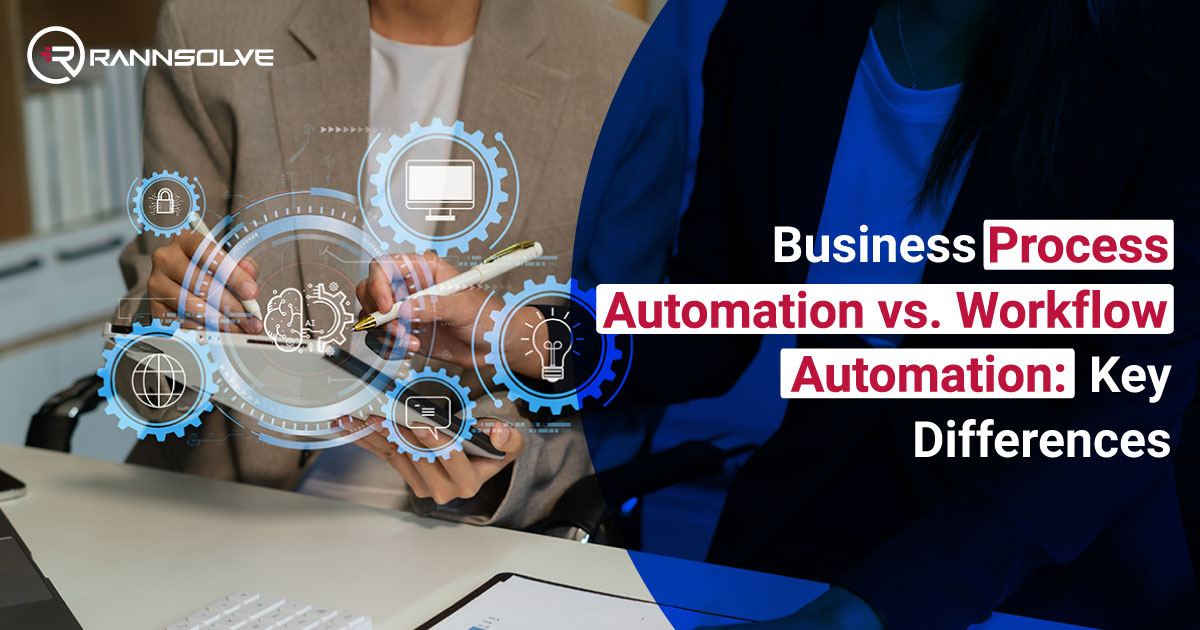
As organizations get bigger, work becomes less about individual tasks and more about how teams coordinate effectively with each other. Information moves between people, teams, and systems, and any error, if at all, adds up big time. Automation relieves people from this complexity, yet results are very much different from one another, as not every automation solution is meant to do the same thing. Some create real momentum, while others only streamline isolated steps. What’s often overlooked is that not all kinds of automation are designed to operate at the same depth within an organization. In this blog, we’ll take a look at the key difference between the two most used kinds of automation by companies, business process automation and AI workflow automation, which are often misunderstood and used interchangeably.
What is Business Process Automation?
Business process automation services focus on automating the business processes A to Z. Often referred to as BPA in short, business process automation tools handle repeatable and multi-step work that would otherwise require manual coordination between people and tools.
The end goal is to reduce human effort where it does not add value and create consistency across how work gets done. Business process automation services connect applications and systems, so information can travel automatically without someone copying data from one place to another. It prevents delays caused by handoffs and reduces errors that show up when tasks are performed differently by different people.
Business process automation services can be applied across many areas and functions. Common examples include supply chain coordination, data entry, customer support workflows, and inventory management. In each case, the process involves multiple steps that must happen in the right order. Business process automation services ensure those steps run reliably and predictably every time. Not all companies have the ability to set up automation in-house, and partnering with business process automation service providers is one of the most sought after option when it comes to implementing automation.
In a competitive environment where speed and accuracy are non-negotiable, business process automation tools help organizations move beyond maintaining the status quo. It gives leaders the ability to improve how the business runs without constantly adding more and more people to oversee or having manual oversight.
Benefits of Business Process Automation Services
Business process automation services are beneficial as they target the root of inefficiency rather than isolated tasks. When implemented thoughtfully, it reshapes how work flows across the organization.
Improved accuracy
Manual work introduces a risk factor, and overlooking it is definitely out of the question. All errors, big or small, such as data entry mistakes, skipped steps, or inconsistent execution, can lead to problems that can become too expensive to fix. Business process automation services reduces these risks by enforcing consistent execution across every run of a process. This is especially important for financial operations and compliance-driven activities where errors carry big consequences.
Cost reduction
Automating multi-step processes reduces the labor required to keep them running smoothly. Organizations often feel that they no longer need additional staff or external support just to manage routine work, which can easily otherwise be done with business process automation tools. Over time, these savings compound and free up budget for areas that actually drive growth.
Automated workflows across systems
Business process automation services help coordinate workflows that span departments, locations, and software platforms. It removes hurdles caused by manual approvals or system weaknesses. By orchestrating end-to-end automation between applications, companies easily prevent chaos at work.
Improved customer experience
When internal processes run smoothly, it’s felt by customers through faster response times, fewer errors, and accurate information. Business process automation tools also allow self-service options that let customers complete tasks or access information without waiting for support. These kind of immediate responses improves customer satisfaction without increasing workload.
What is Workflow Automation?
On the other hand, workflow automation focuses on automating specific sequences of tasks within a process. It deals with how work goes from one step to the next and who or what is responsible at each stage. AI workflow automation uses software to design, execute, and monitor these very task sequences so they run consistently and efficiently.
A simple use case is employee onboarding. Without automation, HR teams manually send forms, run behind approvals, and track progress through email or spreadsheets. With workflow automation, forms are generated automatically, routed based on predefined rules, and tracked in real time. Notifications go out when actions are required, and stakeholders are informed once the process is complete. These result in a smoother onboarding experience for new hires and less administrative burden for HR teams, a win-win scenario.
Benefits of AI Workflow Automation
AI workflow automation delivers value by tightening execution at the task level. It ensures work moves forward without unnecessary delays or confusion.
Efficiency
Automating repetitive tasks speeds up execution and reduces dependence on manual follow-up. Teams spend less time managing work and more time completing it.
Accuracy and consistency
Tasks are executed according to predefined rules every time. This consistency reduces errors and ensures processes are followed as planned.
Time and cost savings
By removing manual intervention from routine activities, AI workflow automation cuts down the time spent on administrative work. The time that can be redirected to higher-value responsibilities.
Compliance
Workflows can include required checks, approvals, and audit trails. This creates transparency and makes it easier to demonstrate compliance when needed.
Data-driven decision-making
Workflow automation tools capture data on task completion times, resource usage, and performance. Leaders can use this data to identify potential challenges and make informed decisions for improvements.
Key Differences Between Workflow Automation And Business Process Automation
While these two approaches overlap or are understood interchangeably as we discussed earlier, they operate at different levels and serve different purposes.
Scope
AI workflow automation defines the sequence of tasks within a specific process, whereas business process automation services automate entire processes across systems and departments.
Execution
While workflow automation maps out both manual and automated steps needed to complete a task sequence, business process automation tools execute those steps automatically wherever possible and reduce the need for human involvement.
Flexibility
Workflows can be adjusted to handle variations and changing requirements, while business process automation tools focus on scalability and optimization by automating repetitive work at scale.
Integration
AI workflow automation integrates with systems to move data and trigger actions, whereas business process automation services connect systems end-to-end so entire processes run without manual handoffs.
Scalability
Workflow automation is often used at the team or departmental level, while business process automation tools are built to handle enterprise-wide processes that span multiple functions and systems.
Customization
Workflow automation typically allows configuration within predefined templates; however, business process automation supports deeper customization with custom rules, logic, and integrations tailored to the organization.
Business Process Automation And Workflow Automation: The Best Of Both Worlds
Workflow automation and business process automation are most powerful when they work together rather than separately (which also works depending on the very needs of a business). AI workflow automation standardizes and streamlines individual task sequences, ensuring that work moves efficiently from one step to the next. These workflows act as the building blocks for broader processes. Business process automation services then take these workflows and connect them across systems, teams, and departments, orchestrating end-to-end operations without manual intervention.
In practice, this tandem approach allows organizations to tackle inefficiencies at both levels. AI workflow automation improves task-level accuracy, speed, and compliance, while business process automation services ensure that those improved tasks fit seamlessly into the larger operational picture. By combining both, companies can easily position themselves for growth and create an environment where employees focus on higher-value work rather than repetitive tasks.
Partner With Rannsolve To Streamline Your Automation Strategy
Choosing between AI workflow automation and business process automation services should be about understanding where each fits and how they support your business goals. At Rannsolve, we help organizations with customizable automation solutions that grow with your business. Whether you are improving a single workflow or rethinking enterprise-wide processes, the right approach makes all the difference. Talk to our automation expert now.
FAQs
AI Workflow automation handles specific task sequences, while business process automation services automate the entire processes across the business ecosystem.
No. AI workflow automation focuses on specific tasks, while business process focuses on broader, complex business operations, often end-to-end.
Examples include automating supply chains, customer support operations, or inventory updates using business process automation tools.
Yes. AI workflow automation improves specific repetitive tasks, and business process automation connects those tasks across the organization for smooth end-to-end operations.