
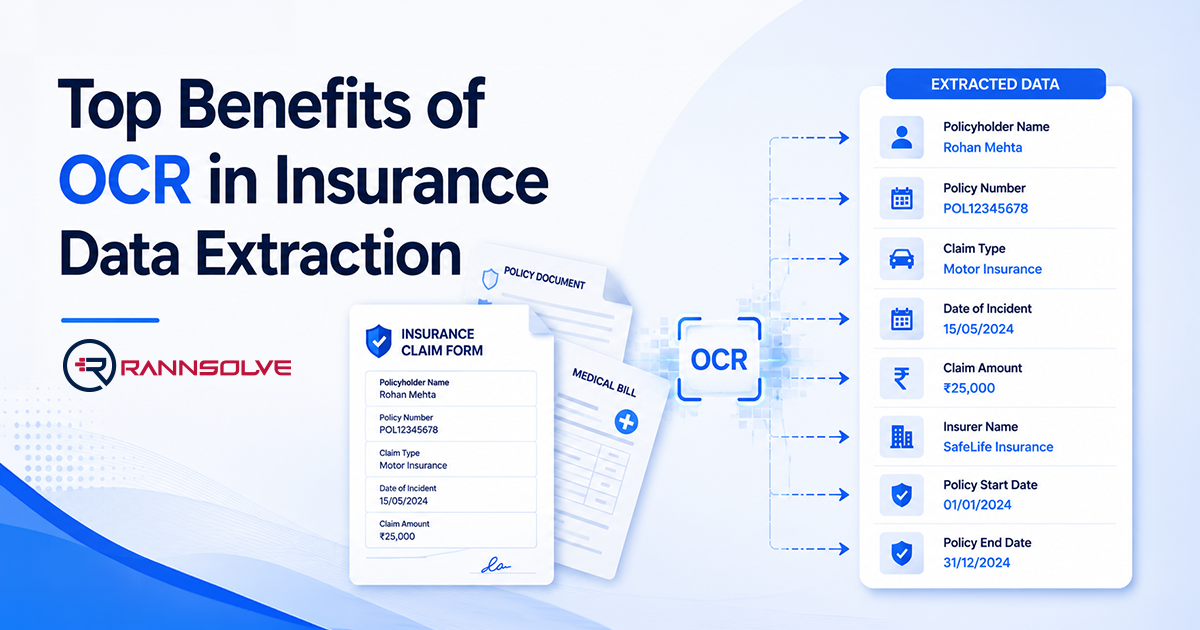
The insurance industry relies on a large amount of paperwork, including policy applications, claims forms, identity proofs, and medical records. Insurers handle thousands of documents daily. Doing this work by hand takes a lot of time and often leads to mistakes. Optical Character Recognition (OCR) technology is changing how insurers manage these tasks with automated data extraction.
OCR lets insurance companies turn printed or handwritten documents into digital files that computers can read and search. When used with automation and AI, OCR makes it much easier for insurers to collect, process, and manage information.
As competition grows, more insurance companies are using insurance OCR solutions to make their work more efficient, improve customer service, and cut costs. Here are the main benefits of using OCR in insurance data extraction and why it is becoming important for today’s insurers.
- Faster Document Processing
One major benefit of automated data extraction is speed. When employees enter data by hand, they have to check each document line by line and type the information into systems. This can take hours or even days, depending on document complexity and volume.
OCR in insurance data extraction speeds up this process by quickly extracting data from scanned documents, PDFs, forms, and images. Claims forms, policy applications, invoices, and customer records can all be handled in just seconds.
This accelerated processing helps insurers approve claims faster, reduce customer waiting times, and increase operational efficiency. Since customer satisfaction in insurance often depends on fast responses, automated insurance data extraction gives companies a real edge over the competition.
- Improved Accuracy and Reduced Human Errors
Entering data by hand often leads to mistakes like wrong policy numbers, misspelled names, or incorrect claim amounts. Even small errors can delay claims, cause compliance problems, or make customers unhappy.
Automated data extraction helps reduce these risks by extracting information straight from documents with high accuracy. Advanced OCR systems that use AI and machine learning can read different fonts, formats, and even handwritten text very precisely.
By reducing human involvement in repetitive tasks, insurance companies can:
- Improve data quality
- Reduce costly errors
- Minimize claim disputes
- Enhance compliance reporting
When data is more accurate, insurance operations run more smoothly and customers trust their insurers more.
- Enhanced Customer Experience
Today’s customers want insurance services to be fast and easy. If claim approvals take too long or onboarding is slow, customers may become dissatisfied.
Automated insurance data extraction makes things better for customers by speeding up document checks and automating processes. Customers can upload their documents online or through mobile apps, and OCR quickly pulls out and processes the needed information.
OCR in insurance data extraction has several benefits for customers including faster claims settlement, quicker policy issuance, reduced paperwork, simplified onboarding, and real-time updates. When customers have a smooth and easy experience, they are more likely to stay with the company and recommend it to others. This helps insurers build a strong reputation in a crowded market.
- Significant Cost Savings
Insurance companies spend a lot of money and time on handling paperwork, entering data, and other admin tasks. Hiring people just to process documents raises costs and slows down work.
OCR in insurance data extraction cuts these costs by automating repetitive tasks and reducing the need for manual work. This lets employees spend more time on important jobs like helping customers, checking for fraud, and making decisions, instead of just entering data.
Cost-saving benefits of insurance OCR solutions include:
- Lower labor costs
- Reduced paper storage expenses
- Decreased processing time
- Fewer correction and rework costs
Over time, automated data extraction with OCR helps companies get more value for their money by making operations more efficient and cutting overhead costs.
- Better Fraud Detection
Insurance fraud is a growing problem around the world. Fake claims and altered documents can cause big financial losses for insurance companies. OCR systems that work with AI and analytics tools can spot inconsistencies and suspicious patterns in documents. By turning documents into digital data, insurers can compare information across many records and find problems more easily.
OCR supports fraud prevention through automated verification processes, data consistency checks, faster cross-document analysis, and improved audit trails. When data is accurate and easy to access with automated insurance data exctraction, insurers can improve their fraud detection and lower financial risks.
- Improved Regulatory Compliance
The insurance industry must follow strict rules and regulations. Keeping accurate records and making sure data is correct are very important for audits and legal reasons.
Insurance OCR solutions helps insurers stay compliant by turning records into digital files and making them easy to search. Automated data extraction also keeps data collection and reporting consistent.
This helps insurance companues with easier document retrieval, improved record management, better audit readiness, and enhanced data security. Because automated data extraction reduces manual work, it also lowers the chance of losing or misplacing documents.
- Scalability for Growing Insurance Operations
As insurance companies grow, the number of documents they handle goes up a lot. Manual processes often can’t keep up with the extra work.
Insurance OCR solutions offers automation that can handle large numbers of documents without losing speed or accuracy. Whether a company is processing hundreds or millions of records, it can easily adjust to business growth. Because OCR in insurance data extraction is flexible, it’s a great choice for insurers who want to modernize and grow their operations.
Partner with Rannsolve for Advanced Automated Data Extraction
Rannsolve’s rannsCDE, an AI-powered Cognitive Data Extractor with the capabilities of high-accuracy OCR and enterprise-grade Intelligent Document Procesisng (IDP), helps insurance companies simplify document processing with an intuitive interface. It enables faster claims handling, improves data accuracy, reduces manual workload and operational costs, and supports compliance with secure digital record management. rannsCDE helps insurers streamline operations and deliver faster, better customer service. Book a 15-minute demo, or talk to our AI expert.
FAQs
OCR (Optical Character Recognition) is a technology that converts printed or handwritten insurance documents into searchable digital data. Insurance companies use OCR to automate data extraction from claims forms, policy applications, invoices, ID proofs, and medical records.
Yes. OCR significantly reduces human errors caused by manual data entry, such as incorrect policy numbers, customer details, or claim amounts. AI-powered OCR systems can extract data with high accuracy from structured and unstructured documents.
Yes. OCR is widely used in health insurance to extract data from medical records, hospital bills, prescriptions, and claim documents. This helps insurers process medical claims more efficiently and accurately.
Modern AI-powered OCR solutions can recognize and extract information from many handwritten insurance documents with high accuracy, depending on handwriting quality and document clarity.
Intelligent Document Processing (IDP) combines OCR, AI, and machine learning to automatically classify, extract, validate, and process insurance documents with minimal human involvement.