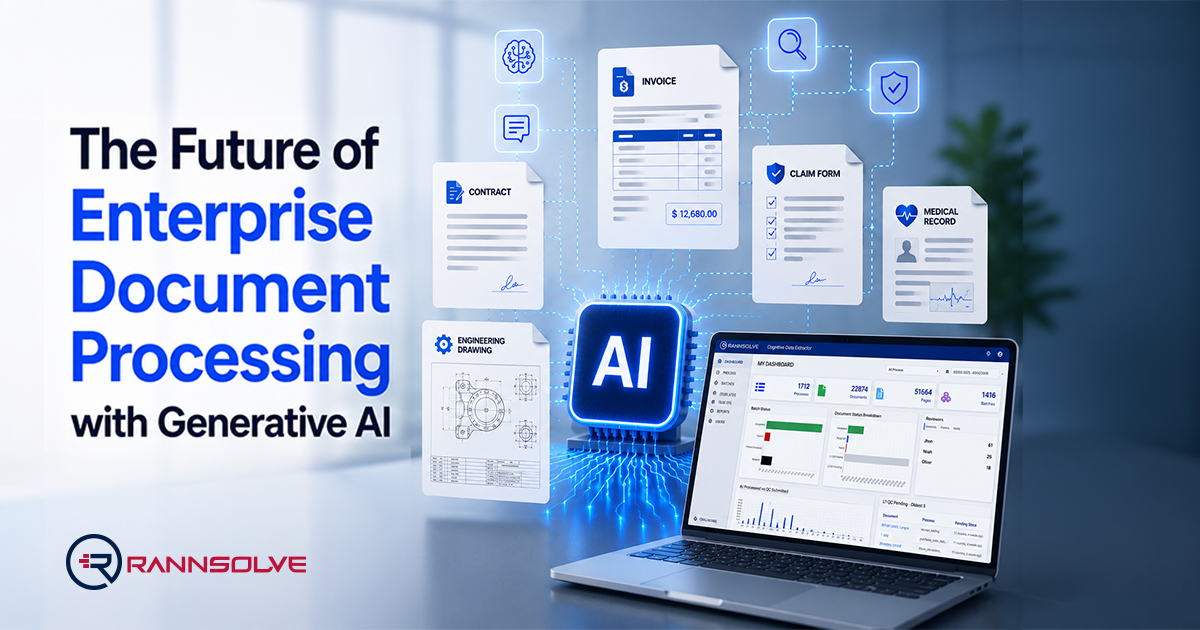
Traditional OCR was built to read characters. Generative AI is built to understand documents. The shift is reshaping how enterprises handle invoices, contracts, claims, and clinical records, and it’s moving faster than most boards realise. 65% of organisations are accelerating AI-driven document automation right now. Here’s what’s actually changing, where it pays back first, and why the next generation of intelligent document processing software runs on LLMs rather than rules.
Walk into any enterprise back office, and the story is roughly the same. Invoices are coming in from 200 different vendor templates. Contracts are moving between legal, procurement, and finance in versions that don’t quite match. Claims are sitting in queues. Onboarding forms are stacking up. Some of those documents are scanned. Some are emailed PDFs. Some are photographs taken on a phone in a warehouse. And nearly all of them still require human hands to read, validate, and key into systems of record.
Optical Character Recognition (OCR) made the first dent in this problem decades ago by converting scanned text into machine-readable data. Intelligent Document Processing (IDP) extended that into classification, validation, and workflow. Now, Generative AI is taking the next step, and it’s the biggest one. AI document automation built on Large Language Models doesn’t just read the document. It understands what the document means, summarises it, answers questions about it, and acts on it inside an enterprise workflow. The intelligent document processing market grew to $10.57 billion in 2025 and is on track for $91 billion by 2034, and most of that growth is being driven by exactly this shift.
How Enterprise Document Processing Got Here
Four phases. Each one solved a problem the previous one couldn’t. Manual processing relied on paper-based workflows and human data entry, which limited speed and scaled badly with volume. Traditional OCR digitised the text but missed context, validation, and any kind of decision-making. Intelligent Document Processing brought AI-powered extraction, document classification, and workflow orchestration into the picture, which was a step change. And now Generative AI is moving enterprises into a fourth phase, where the system understands meaning, answers questions about documents, and orchestrates workflows the way an experienced operator would.
Each phase was a real improvement. None of them solved the whole problem on their own. The gap between traditional OCR and cognitive data extraction is where most enterprises still live today, and it’s exactly the gap Generative AI is closing.
What Does Generative AI Actually Bring to Document Processing?
Contextual Understanding, Not Just Extraction
Traditional OCR reads characters on a page. Generative AI reads meaning. The same invoice comes in from a German vendor labelled Rechnung Nr. and a US vendor labelled Invoice No. The LLM recognises that those refer to the same field. It distinguishes invoice totals from due dates from payment terms. It picks up that a scrawled signature belongs in the approval box. It notices when a line-item total doesn’t match the sum above it. Context is what makes AI document automation reliable across the messy variety of formats real enterprises actually receive.
Document Summarisation at Enterprise Scale
Contracts run 60 pages. Clinical records run hundreds. Insurance claims, legal case files, compliance reports, vendor agreements: most enterprise documents are too long for anyone to read in full. Generative AI generates concise, accurate summaries that surface the clauses, dates, and dollar amounts that actually matter, in seconds. The result is decisions made on the substance of a document rather than on whoever happened to read it last.
Conversational Document Intelligence
The next shift is the interface. Employees stop hunting through PDFs and start asking the document directly. What’s the payment amount? When does this contract auto-renew? Which compliance clauses are missing? Show me the patient’s last three diagnoses. Modern AI document automation systems handle those questions in natural language, drawing answers from the document and citing the source. For most knowledge workers, this is the single biggest productivity unlock of the generative AI era.
Intelligent Workflow Automation
Once a document is understood, the workflow can act on it. AI document automation built into enterprise workflows routes invoices for approval, flags anomalies before they hit downstream systems, validates fields against business rules, and generates the responses that used to sit in someone’s inbox waiting for a manual draft. High-confidence extractions flow straight through to the ERP. Ambiguous cases route to a reviewer. Exceptions surface before they cause rework.
Higher Extraction Accuracy Across Every Document Type
Modern intelligent document processing software now achieves 99 to 99.9% accuracy on structured documents, with semi-structured and unstructured documents not far behind. Industry benchmarks point to invoice errors dropping by 37%, document-loss incidents falling by 90%, and average extraction accuracy lifting from 85% to 97% once Generative AI joins the pipeline. The models learn continuously, so accuracy curves trend upward rather than downward as document volume grows.
Semantic Search and Knowledge Discovery
Traditional search retrieves by keyword. Semantic search retrieves by meaning. Employees looking for the indemnity clause don’t have to remember whether it was called indemnity, liability, or limitation of damages. The system finds it anyway. For organisations sitting on decades of historical records, semantic search turns dormant archives into active operational knowledge.
Where Are Enterprises Using Generative AI Document Processing Today?
Five industries are leading adoption, and the patterns inside each one are useful to understand. Healthcare organisations use AI document automation for medical chart summarisation, prior-authorisation workflows, clinical documentation, claims processing, and patient-record extraction. The administrative burden that drives clinician burnout is exactly the burden Generative AI is built to take.
Financial institutions automate invoice processing, loan documentation, KYC workflows, financial reporting, and compliance analysis. The 78% of enterprises now operational with AI are heavily weighted toward financial services, where document-heavy operations meet tight regulatory frameworks. Insurance providers streamline claims reviews, underwriting, policy analysis, fraud detection, and customer onboarding. Legal teams compress contract analysis, discovery, clause extraction, and case summarisation work that used to consume junior associates for weeks. Logistics enterprises automate bills of lading, customs paperwork, shipment documentation, and vendor records, which is where AI document classification matters most because every shipment type carries its own paperwork fingerprint.
The Role of Large Language Models
Large Language Models are the engine. They give AI document automation the ability to understand human language, analyse document meaning, identify patterns, generate intelligent outputs, and support reasoning across multi-step workflows. The best intelligent document processing software now combines fine-tuned LLMs with computer vision models for layout understanding and proprietary AI-vision algorithms for low-quality scans, handwriting, and damaged documents. No single model handles the full range of real-world enterprise content. The trick is the orchestration between them.
Why Human-in-the-Loop Still Matters
Full automation is rarely the right goal, even with Generative AI in the stack. The most effective AI document automation deployments keep humans in the loop for sensitive validation, exception handling, and the decisions that carry compliance or financial weight. The AI drafts. The human decides. Every step gets logged. That hybrid model delivers the throughput of automation with the judgment of experienced operators, which is exactly what regulators expect to see in audit.
The Challenges Enterprises Have to Address
Generative AI document processing isn’t a drop-in upgrade. Four challenges show up in almost every deployment. Data privacy and security require encryption, controlled AI environments, and compliance frameworks that travel with the document. AI governance needs validation controls, audit trails, human oversight, and clear risk-management policies, especially in regulated industries. Integration complexity is real: the platform has to talk to ERPs, CRMs, EHRs, enterprise databases, and the workflow tools those systems already feed. And change management matters as much as the technology. Training, adoption strategies, and operational alignment are what determine whether the platform gets used or quietly bypassed. Organisations that win with AI document automation invest in all four alongside the technology itself.
How rannsCDE Brings Generative AI to Enterprise Document Workflows
rannsCDE is Rannsolve’s AI-powered intelligent document processing platform, built to modernise enterprise document operations end to end. The platform combines fine-tuned Large Language Models, custom deep learning models, and proprietary AI-vision algorithms with 25 years of Rannsolve’s domain expertise. It reads structured, semi-structured, and unstructured documents at 99.5% extraction accuracy and ships with over 300 pre-trained document templates across healthcare, finance, legal, insurance, and e-commerce.
The capabilities map directly to where enterprises are now: AI-powered data extraction across every common document type, intelligent AI document classification that identifies new document types automatically, workflow automation for approvals and routing, and Human-in-the-Loop validation for the edge cases that still need human judgment. Enterprise integrations connect rannsCDE into ERP, CRM, EHR, and cloud environments, with secure deployment options across cloud, private cloud, and on-premise. The result is the kind of AI document automation enterprises can actually run in production, not a pilot.
Talk to our AI document automation experts or book a 15-minute demo of AI-powered rannsCDE.
FAQs
Generative AI in enterprise document processing uses Large Language Models to read, understand, summarise, and act on documents in a human-like way. Unlike traditional OCR, which only extracts text, Generative AI interprets context, answers questions about the document, and supports decision-making inside enterprise workflows.
Generative AI handles structured documents (invoices, forms), semi-structured documents (contracts, claims), and unstructured documents (emails, reports, clinical notes). Modern AI document automation platforms read scanned, faxed, emailed, and photographed documents across multiple languages and even handwritten content.
Generative AI combines vision models, language models, and business-rule engines to extract fields with contextual understanding rather than rigid template matching. Modern intelligent document processing software now achieves 99 to 99.9% accuracy on structured documents, and AI document classification handles new document types automatically without retraining.
Full automation is rarely the right goal for sensitive workflows. Human-in-the-loop validation keeps humans involved on the decisions that carry compliance or financial weight, while the AI handles the volume work. The hybrid model delivers automation throughput with human judgment, which is what regulators expect to see in audit.
Yes. Modern AI document automation combines AI-vision algorithms, OCR, and language models to read handwritten content, low-quality scans, and damaged documents in the same pipeline as printed text. Quality control workflows and human-in-the-loop review handle the edge cases that still need judgment.