Traditional OCR tops out at around 60% accuracy on real-world enterprise documents and forces employees to spend up to 40% of their time on manual correction. Modern intelligent document processing platforms achieve 99-99.9% accuracy and validate data 5 times faster.
Enterprise document workflows look impressive on the organisation charts and messy in the back office. Invoices arrive from hundreds of vendors in dozens of templates. Contracts move between legal, procurement, and finance in versions that don’t quite match. Patient records, claims, bills of lading, KYC forms, compliance reports, and emails each carry data the business needs, and each one still passes through human hands before that data becomes useful.
Optical Character Recognition (OCR) was the first real attempt to fix that problem. For two decades, OCR converted scanned pages into machine-readable text and saved enterprises from having to type everything by hand. But OCR was built for a simpler era. Today’s documents are more varied, more unstructured, and far higher volume than OCR was ever designed to handle. This is why enterprises are now moving past OCR and toward intelligent document processing, the platform layer that actually understands documents rather than just transcribing them.
Why Did OCR Work for So Long?
OCR solved a real problem. It digitized paper records, converted scanned invoices into searchable text, archived documents at scale, and pulled the most basic fields from standardized forms. For many early use cases, that was enough. But today, the honest answer is that OCR didn’t disappear because it was bad. It got replaced because the documents got harder.
Where Does OCR Actually Break Down in the Modern Enterprise?
- OCR Reads Characters, Not Meaning
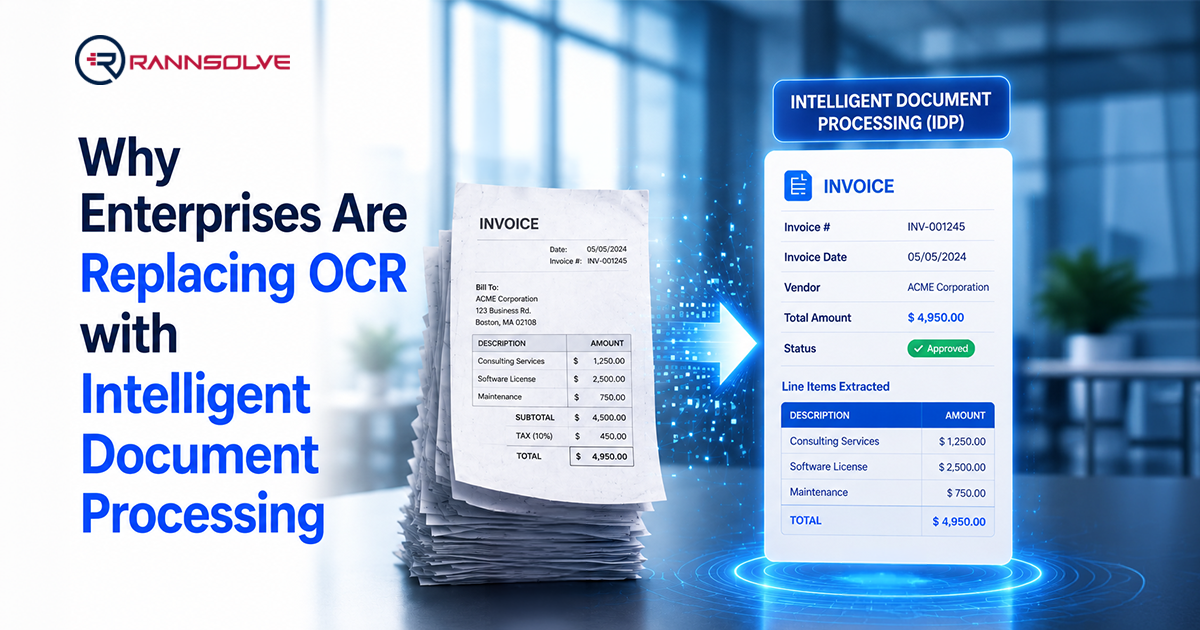
Traditional OCR recognises text. It doesn’t interpret it. The system can extract an invoice number, a date, and a total, but it can’t tell you whether the date matches the purchase order, whether the total reconciles against the line items, or whether the vendor name is one you’ve already approved. Context is what makes data useful in an enterprise workflow, and context is exactly what OCR was never built to provide.
- Template Dependency Doesn’t Scale
Most OCR systems rely on predefined templates. That works fine when every invoice from every vendor looks the same. It breaks the moment a vendor updates its template, a new supplier joins the AP queue, or a form arrives with fields in a slightly different order. Enterprises processing thousands of document variations spend more time maintaining templates than processing the actual documents.
- Unstructured Data Defeats OCR
Most enterprise content is unstructured now. Emails. Contracts. Clinical notes. Claims narratives. Handwritten forms. Multi-page PDFs with mixed layouts. Traditional OCR can read the characters on those documents, but can’t make sense of what they mean as business records. The gap between traditional OCR and cognitive data extraction is widest exactly where the document is most valuable: in unstructured cases that require interpretation.
- Manual Validation Eats the Productivity Gains
OCR typically achieves around 60% accuracy on real-world enterprise documents before limitations kick in. The remaining 40% is handled by a human reviewer who corrects errors, validates fields, fixes formatting, and rekeys anything OCR couldn’t handle. Industry research consistently shows employees spending up to 40% of their time on manual data correction in OCR-heavy workflows. That’s not a productivity gain. That’s a slower way to do the same job.
- No Workflow, No Decisions, No End-to-End Automation
OCR extracts text. It doesn’t route invoices for approval, validate against business rules, classify document types, or push clean data into the ERP. Modern enterprises need all those capabilities, and they need them on a single platform. OCR alone leaves a gap between digitised text and actual automation that the rest of the stack must fill, often through brittle integrations and extensive manual operations.
What Is Intelligent Document Processing?
Intelligent document processing is the platform layer that does what OCR can’t. It combines OCR for text recognition with AI for context, machine learning for adaptation, natural language processing for unstructured content, workflow automation for end-to-end orchestration, and human-in-the-loop validation for the edge cases that need judgment. Modern intelligent document processing software now also folds Generative AI and Large Language Models into the pipeline, which is why the accuracy and capability gap between OCR and IDP has widened so sharply over the last 24 months.
Intelligent document processing turns documents from a friction point into a data source, which is what makes AI document processing and document processing automation actually deliver value at enterprise scale. Where OCR digitizes the page, AI document processing digitizes the workflow.
OCR vs Intelligent Document Processing at a Glance
Feature | Traditional OCR | Intelligent Document Processing |
Text Recognition | Yes | Yes |
Context Understanding | No | Yes |
AI-Based Extraction | Limited | Advanced |
Workflow Automation | Minimal | End-to-End |
Unstructured Data Support | Weak | Strong |
Learning Capabilities | No | Yes |
Validation Workflows | Manual | AI + Human-in-the-Loop |
Enterprise Integration | Limited | Extensive |
Scalability | Moderate | High |
Why Are Enterprises Moving to IDP Right Now?
Four pressures are pushing enterprises off OCR faster than most predicted. Document volumes keep climbing as digital channels generate more content than physical channels ever did, and OCR-based pipelines don’t scale with that growth without adding headcount. Business decisions need to move faster, which means approvals, claims, and customer responses can’t sit in a queue waiting for manual validation. Digital transformation programs that started with cloud and analytics are now reaching the workflow layer, where AI document processing is the obvious next step. And compliance frameworks like HIPAA, SOC 2, GDPR, and ISO 27001 are getting stricter about audit trails, field-level validation, and PII handling, all of which intelligent document processing enforces on the platform and OCR leaves in spreadsheets.
Which Industries Are Replacing OCR First?
Five industries lead the shift, and the patterns within each are worth understanding. Healthcare organizations use intelligent document processing for patient chart processing, prior authorization automation, clinical documentation, and claims processing. The administrative burden that drives clinician burnout is exactly the burden that IDP is built to take on. Financial institutions automate invoice processing, loan documentation, KYC verification, and compliance workflows, which is why BFSI represents nearly a third of the IDP market in 2026. Insurance providers compress claims forms, policy documentation, and risk-assessment work that used to consume underwriting teams for hours per case. Legal teams reduce contract review, discovery, and case documentation work from weeks to days. And logistics enterprises automate bills of lading, customs paperwork, shipment records, and freight documentation, where the move from OCR to IDP often pays off fastest because the variety of documents is highest.
Why Human-in-the-Loop Still Matters
Full automation is rarely the right goal, even with Generative AI in the stack. The most effective AI document automation deployments keep humans in the loop for sensitive validation, exception handling, and the decisions that carry compliance or financial weight. The AI drafts. The human decides. Every step gets logged. That hybrid model delivers the throughput of automation with the judgment of experienced operators, which is exactly what regulators expect to see in audit.
What Do Enterprises Actually Gain?
Five outcomes appear in nearly every deployment we’ve seen. Operational costs drop as manual keying and rework get removed from the workflow. Accuracy lifts from the 60% OCR baseline to 99% or better, which means downstream systems get cleaner data and exception queues shrink. Processing times accelerate, with AI document processing delivering up to 3x faster data validation than traditional OCR pipelines. Compliance improves because the platform enforces audit trails and validation rules. And document processing automation finally scales without proportional growth in headcount, which is what makes the math work for fast-growing enterprises.
How rannsCDE Delivers Enterprise-Grade Intelligent Document Processing
rannsCDE is Rannsolve’s AI-powered intelligent document processing platform, designed for enterprises ready to move beyond OCR. The platform combines fine-tuned Large Language Models, proprietary AI vision algorithms, and 25 years of domain data into a single pipeline that reads structured, semi-structured, and unstructured documents with 99.5% extraction accuracy. Over 300 pre-trained templates ship out of the box for healthcare, finance, legal, insurance, and e-commerce.
The capabilities map directly to what enterprises need from modern document processing automation. AI document processing automatically classifies new document types. Intelligent data extraction supports all common formats. Enterprise integrations plug rannsCDE into ERP, CRM, EHR, and cloud environments. Human-in-the-loop validation handles the edge cases that still need judgment. And secure deployment options across cloud, private cloud, and on-premise mean the platform fits the compliance posture your business already operates under.
Talk to our intelligent document processing expert or book a 15-minute demo.
FAQs
Because OCR reads characters but doesn’t understand documents, traditional OCR tops out around 60% accuracy on real-world enterprise content, depends heavily on templates, and leaves up to 40% of the work to manual reviewers. Intelligent document processing closes all three gaps with AI-driven extraction, contextual understanding, and end-to-end workflow automation.
Yes. Modern IDP platforms are built to integrate with ERP, CRM, EHR, accounting, and workflow tools through APIs, connectors, and event-driven architectures. rannsCDE in particular supports cloud, private cloud, and on-premise deployments, so it fits the compliance and infrastructure posture the enterprise already runs.
Intelligent document processing is a platform layer that combines OCR, AI, machine learning, natural language processing, workflow automation, and human-in-the-loop validation into a single pipeline. It reads documents, understands their meaning, validates the extracted data, and automatically pushes it into enterprise workflows.
OCR is one component of IDP. OCR recognizes text on a page. Intelligent document processing adds context, classification, validation, automation, and integration on top of OCR, which is what allows enterprises to move from digitized text to actual document automation across structured, semi-structured, and unstructured content.
Yes. Intelligent document processing is an applied AI technology. It uses machine learning for classification and extraction, natural language processing for unstructured content, computer vision for layout understanding, and increasingly Large Language Models and Generative AI for summarisation, reasoning, and conversational interfaces.