Documents are part of every workflow in every industry. Manually processing them is time-consuming and error-prone. According to IDC research, manual document handling can reduce productivity by about 21%, meaning a fifth of the workweek is lost to paperwork. Enterprises have dealt with these losses for years, which is why many businesses are switching to AI-powered document processing to reap its benefits. This shift can cut costs by up to 60%, speed up processing by 70%, and deliver a 200-300% ROI in the first year. These improvements come from changing how operations work, since document tasks no longer slow things down.
What's Actually Changing Inside Enterprise Operations?
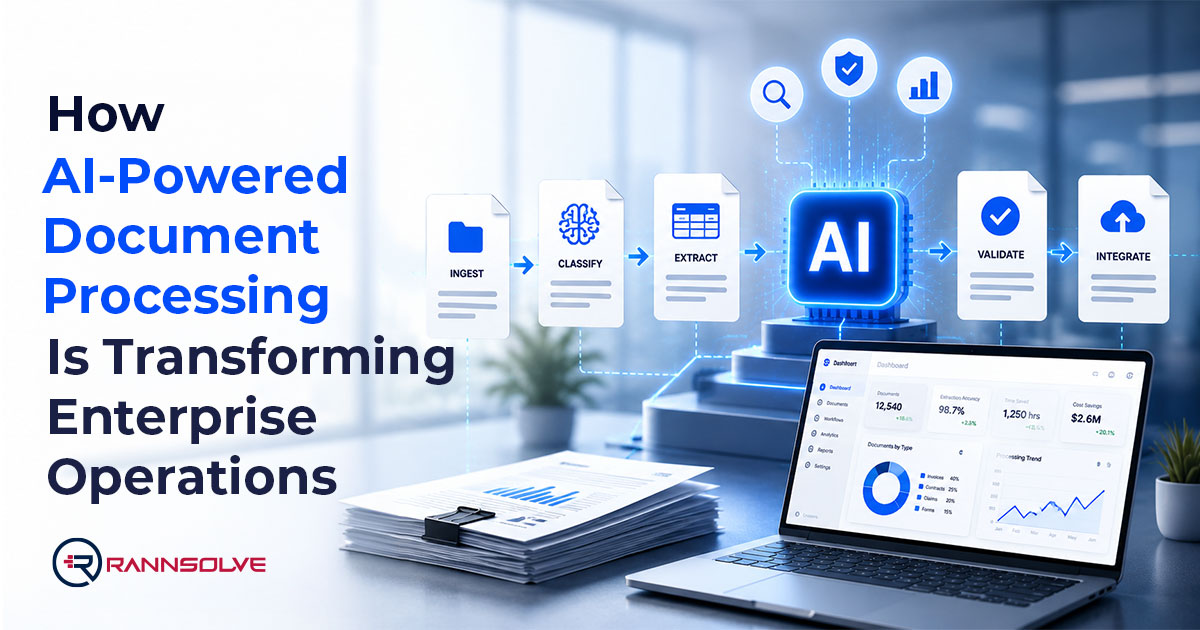
The most obvious change is faster processing, but the bigger shift is in how the work is done. Before AI-powered document processing, a document would arrive, wait in an inbox or scanning queue, be manually sorted, entered into a system, sent for approval, corrected, re-entered, and finally posted to the ERP. This took hours of work and days to complete. With intelligent document processing, documents are automatically classified, and data is extracted, checked against business rules, sent for approval only if needed, and posted to the ERP all in minutes, with no manual data entry.
What Is AI-Powered Document Processing?
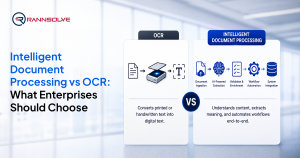
AI-powered document routing is the platform layer that postdates enterprise document processing, which automates the extraction, classification, validation, and management of business documents from start to finish. It uses intelligent OCR software, AI, machine learning, natural language processing, workflow automation, human-in-the-loop validation, and Generative AI. Unlike traditional or basic intelligent OCR software, it goes beyond reading text. It understands context, applies business rules, and takes action within real workflows. This is what sets full intelligent document processing solutions apart from simple OCR software.
Stage 1: Document Ingestion
Documents come in through every channel a business uses, such as email attachments, scanned uploads, PDFs from cloud storage, mobile photos from the field, and direct feeds from enterprise applications. The platform consolidates all these documents into a single processing queue, so operations teams no longer have to sort them manually.
Stage 2: Intelligent Document Classification
AI models determine the type of each document, such as invoices, contracts, claim forms, patient records, bills of lading, or onboarding forms. This classification step replaces the manual sorting that used to occupy entire mailrooms or shared inboxes, and it automatically routes each document to the appropriate workflow.
Stage 3: Intelligent Data Extraction
The platform extracts key business information, including invoice numbers, customer details, dates, totals, policy information, shipment details, and clinical findings. Both structured and unstructured documents undergo the same extraction process, something traditional OCR could not reliably handle.
Stage 4: Contextual Understanding
Natural Language Processing helps the system understand meaning, not just text. For example, it knows that the date next to ‘Due’ is the payment due date, the amount above the tax line is the subtotal, and a signature block belongs to an authorized approver. This move from simple extraction to real understanding is where AI-powered document processing outperforms older OCR systems.
Stage 5: Validation and Quality Control
AI-powered validation catches missing fields, inconsistent values, duplicate entries, and formatting problems before they reach other systems. Most issues are fixed automatically by the platform. Only cases that require real judgment go to a human reviewer, which keeps accuracy high and avoids the manual backlog that traditional OCR often creates.
Stage 6: Workflow Automation
Once the data is ready, the platform sends it where it needs to go such as for approvals, compliance checks, ERP systems, CRM updates, EHR systems, or claims platforms. Integrating the workflow from end to end turns document processing from a back-office task into a core part of business operations.
How Different Industries Benefit from AI Document Processing
Five industries benefit the most:
- Healthcare uses AI document processing for tasks like patient chart extraction, prior authorizations, claims processing, and digitizing medical records, which helps reduce administrative work and clinician burnout.
- Financial institutions automate invoice processing, loan documents, KYC checks, compliance reports, and account onboarding, making BFSI the largest segment in the IDP market.
- Insurance companies speed up claims, policy documents, underwriting, and onboarding.
- Logistics and supply chain teams automate bills of lading, shipment records, customs paperwork, and freight documents.
- Legal organizations use it for contract analysis, legal discovery, compliance reviews, and case documentation. In all these industries, documents are no longer the bottleneck.
How AI-Powered Document Processing Supports Digital Transformation
Most enterprise digital transformation efforts lack one key thing: clean, structured data. Cloud migration provides infrastructure, analytics tools create dashboards, and AI projects build models. But the data for all these tools is often stuck in PDFs, scanned files, paper documents, emails, and unstructured records. Modern document processing turns this trapped information into useful business intelligence, enabling automation, better analytics, AI-driven decisions, modern workflows, and scalable operations. Without this document layer, the rest of the transformation relies on incomplete data.
The Role of Generative AI in Document Processing
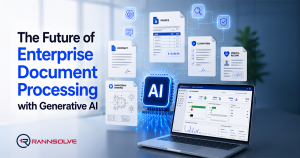
Generative AI is the latest addition to document processing and is changing what enterprise workflows can do. Large Language Models can now summarize long documents in seconds, answer questions in natural language, draft responses, and find insights hidden in multi-page records. This is a big change. Where once AI-powered document processing used to focus on extraction, it’s now about understanding, reasoning, and creating with Generative AI. In the future, enterprise workflows will rely more on AI agents, conversational document intelligence, predictive automation, and autonomous workflow management, all built on the foundation of today’s intelligent document processing solutions.
What Business Outcomes Do Enterprises Actually See?
Almost every large-scale deployment of enterprise document processing delivers six main results. Processing times drop from hours to minutes. Operational costs go down as manual data entry, rework, and exception handling are reduced. Extraction and validation accuracy improves from about 60% with OCR to 99% or more. The system scales easily as document volumes grow, without needing more staff. Compliance improves with audit trails, validation workflows, and regulatory controls. Finally, business operations become smarter as the data from document processing supports analytics, planning, and decision-making.
What Happens When Enterprises Don't Modernize?
Organizations that still use manual workflows or basic OCR software face the same problems. Processing delays build up across departments. Operational costs rise with volume instead of revenue. Scalability issues lead to overtime, extra contractor costs, or limited growth. Poor data quality hurts analytics and reporting. Employees in document-heavy roles experience burnout. Compliance risks increase due to inconsistent validation and audit trails. Inefficient document processing slows down every department. The longer companies wait to modernize, the further they fall behind competitors who are already using intelligent document processing.
How rannsCDE Brings Intelligent Document Processing Solutions to Enterprises
rannsCDE, an AI-powered Intelligent Document Processing platform, is designed to modernize enterprise document operations from start to finish. It uses advanced Large Language Models, proprietary AI-vision algorithms, and 25 years of domain data in a single pipeline, achieving >99.5% extraction accuracy for structured, semi-structured, and unstructured documents. With over 300 pre-trained templates for healthcare, finance, legal, insurance, and e-commerce, organizations can deliver value faster than building solutions from scratch. Human-in-the-loop quality checks validates cases that still need a careful set of human eyes. And secure deployment options across cloud, private cloud, and on-premise mean the platform fits whatever compliance posture your business already runs under. Talk to our intelligent document processing expert now.
FAQs
Yes, an AI-powered document-processing platform like rannsCDE can integrate with ERP and CRM systems via APIs to automate data extraction, validation, and workflow management.
Generative AI improves enterprise document processing by understanding context, extracting insights, and processing unstructured documents more quickly and accurately.
Enterprises should choose Intelligent Document Processing Solutions that offer high accuracy, automation, scalability, security, and seamless system integrations.
Intelligent OCR Software speeds up document handling and reduces errors, helping businesses deliver faster responses and smoother customer experiences.
Yes, Intelligent Document Processing Solutions are scalable and cost-effective, making them suitable for small and mid-sized businesses as well.