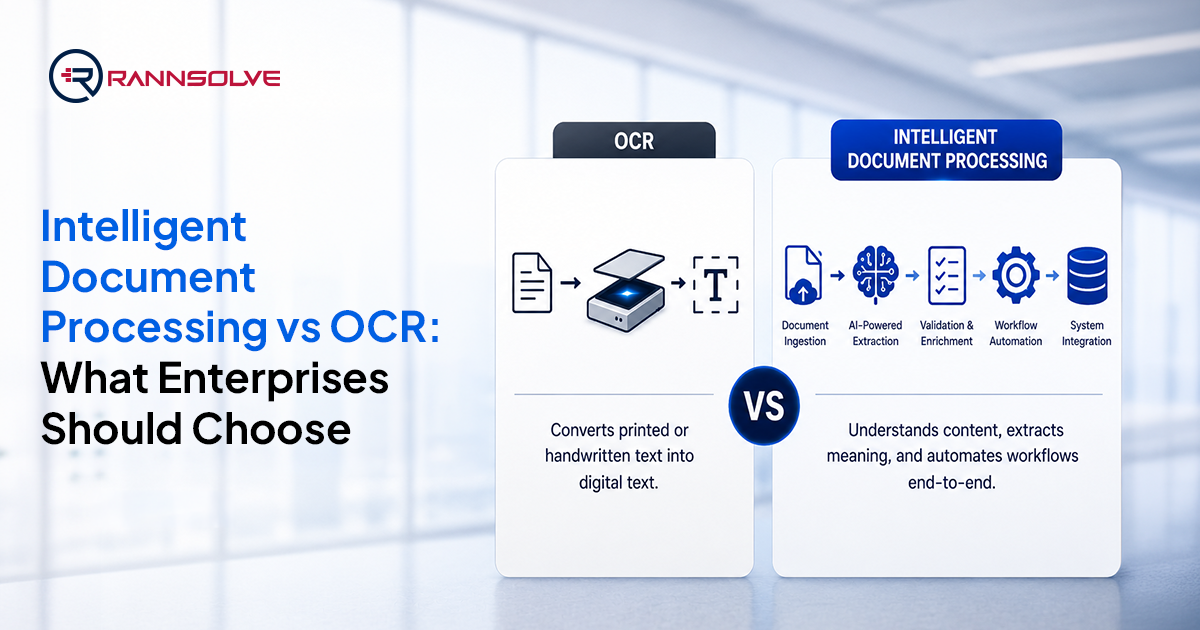
Optical Character Recognition, or OCR, is mature, cheap, and good at one job: turning printed text into digital text. Intelligent document processing (IDP) is broader, smarter, and built for the workflows OCR can’t handle. Most enterprises end up running both. The real question is which documents belong to OCR and which belong to AI document processing. This guide is the decision framework: where each one fits, where each one breaks, and how to choose without over-buying or under-investing.
Enterprise leaders evaluating document processing automation usually hit the same fork in the road. On one side: OCR. Familiar, predictable, inexpensive, and good at exactly what it was designed for. On the other side: intelligent document processing. Newer, more capable, and powered by AI that can handle the documents OCR was never built to read. Both are real options. Both have a place. The mistake most teams make is treating it as an either-or decision when the better answer is almost always a portfolio.
The numbers explain why the conversation’s shifted. OCR typically achieves around 60% accuracy on real-world enterprise documents before the manual review queue takes over. Intelligent document processing platforms now operate at 99-99.9% accuracy and validate data 3 times faster than traditional OCR pipelines.
What Is OCR, and How Does It Work?
Optical Character Recognition is a technology that converts printed or handwritten text in scanned documents, images, and PDFs into machine-readable digital text. The workflow’s straightforward: a document gets scanned, the image gets preprocessed, the system identifies character shapes against a trained model, text gets extracted, and a human reviewer corrects whatever the system got wrong.
What Is Intelligent Document Processing, and How Does It Work?
Intelligent document processing combines OCR with AI, machine learning, natural language processing, workflow automation, human-in-the-loop validation, and now Generative AI into a single pipeline. The full IDP workflow covers document ingestion, AI-driven classification, intelligent data extraction, contextual understanding, validation, automated routing, and integration with the enterprise systems that need the data. While OCR digitizes the page, IDP digitizes the entire workflow surrounding it.
Difference between OCR and Intelligent Document Processing & Why enterprises are moving from OCR to IDP
Text recognition versus document understanding: OCR extracts characters, while IDP extracts meaning, relationships, and business context. Structured versus unstructured documents: OCR performs well on rigid templates, while IDP processes structured forms, semi-structured invoices, and fully unstructured emails or contracts inside the same pipeline. Manual versus intelligent validation: OCR sends most exceptions to a human reviewer, while IDP applies AI-based validation first and routes only the edge cases that truly require a person.
A quick glance:
|
Feature |
OCR |
Intelligent Document Processing |
|
Text Recognition |
Yes |
Yes |
|
Contextual Understanding |
No |
Yes |
|
AI-Powered Extraction |
Limited |
Advanced |
|
Unstructured Document Support |
Weak |
Strong |
|
Machine Learning |
No |
Yes |
|
Workflow Automation |
Minimal |
End-to-End |
|
Human Validation |
Extensive |
Intelligent Review |
|
Scalability |
Moderate |
High |
|
Enterprise Integration |
Limited |
Extensive |
|
Learning Capabilities |
No |
Yes |
Five forces are tipping the balance toward intelligent document processing across almost every industry. Operational efficiency is the first: document processing automation removes manual keying, rework, and exception queues, allowing the same team to handle far more volume. Data accuracy is the second: AI-driven validation lifts extraction quality across invoices, contracts, claims forms, medical records, and logistics documentation from the 60% OCR baseline to 99% or better.
Faster business decisions are the third: real-time access to clean document data compresses approvals, customer responses, reporting, and analytics cycles. Compliance and governance is the fourth: modern IDP platforms ship with audit trails, validation workflows, encrypted processing, and the regulatory controls that healthcare, finance, insurance, and legal teams need by default. And scalability is the fifth: document processing automation absorbs growing document volumes without forcing proportional headcount increases, which is the part that finally makes the unit economics work for fast-growing enterprises.
When Should Enterprises Still Use OCR?
OCR earns its keep in narrow, predictable workloads. Simple document digitization, where the goal is searchable text rather than business data. Low-volume archival projects, where the cost of a full IDP deployment exceeds the return. Standardized forms with fixed layouts that almost never change. Light-touch use cases where text extraction is the whole job and no downstream workflow depends on the output. For those scenarios, modern OCR software is still a solid, cost-effective choice. The mistake is using OCR for workloads that have outgrown it.
When Should Enterprises Choose Intelligent Document Processing?
Intelligent document processing is the right choice when the workflow involves high document volumes, AI-driven document processing automation, unstructured data, end-to-end workflow orchestration, intelligent validation, enterprise-scale integrations, or genuine operational scalability. In practice, that covers most enterprise document workflows today. If the documents are varied, the volume is climbing, or the data needs to flow into another system without manual touch, IDPs are almost always the right call. AI document processing pays back faster than most teams expect, especially in document-heavy functions like AP, claims, KYC, and clinical documentation.
How rannsCDE Brings Enterprise-Grade IDP to Production
rannsCDE is Rannsolve’s AI-powered intelligent document processing platform, built for enterprises ready to make this exact decision. The platform combines fine-tuned Large Language Models, proprietary AI vision algorithms, and 25 years of Rannsolve’s domain data into a single pipeline that reads structured, semi-structured, and unstructured documents with 99.5% extraction accuracy.
The capabilities map directly to where enterprises are putting IDP today. AI-driven document classification automatically identifies new document types. Intelligent data extraction supports all common formats. Human-in-the-loop validation covers the edge cases that still need judgment. Workflow automation routes approvals, validations, and exceptions without manual handoffs. Enterprise integrations plug rannsCDE into ERP, CRM, EHR, and cloud environments, with cloud, private cloud, and on-premise deployment options to match the compliance posture your business already runs.
Talk to our AI document automation experts or book a 15-minute demo of AI-powered rannsCDE.
FAQs
Intelligent document processing is an AI-powered platform that automates the full document workflow, from ingestion through extraction, validation, and integration. It combines OCR, machine learning, natural language processing, workflow automation, and human-in-the-loop validation into a single pipeline, increasingly with Generative AI capabilities folded in.
OCR recognizes and extracts text from scanned documents, but doesn’t understand meaning, context, or business relationships. Intelligent document processing adds AI-driven classification, contextual understanding, intelligent validation, workflow automation, and enterprise integration on top of OCR, which is what lets it handle unstructured documents and end-to-end automation.
Structured documents like invoices and standardized forms, semi-structured documents like contracts and claims, and unstructured documents like emails, reports, clinical notes, and handwritten content. Modern IDP platforms read scanned, faxed, emailed, and photographed documents across multiple languages in the same pipeline.
Yes. AI document processing combines vision models, language models, and machine learning to read unstructured documents with contextual accuracy. Quality control workflows and human-in-the-loop validation handle the edge cases that still need judgment, while the models keep learning from every correction. That’s the difference between extracting text and actually understanding what’s on the page.
Healthcare, finance, insurance, legal, and logistics lead adoption. Healthcare uses AI document processing for medical record automation and claims. Finance uses it for invoice processing automation, KYC, and loan documentation. Insurance and legal use it for claims and contract workflows. Logistics uses it for bills of lading, customs, and freight paperwork.