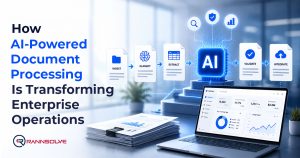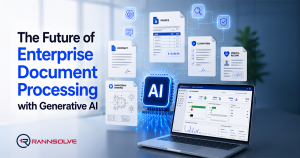
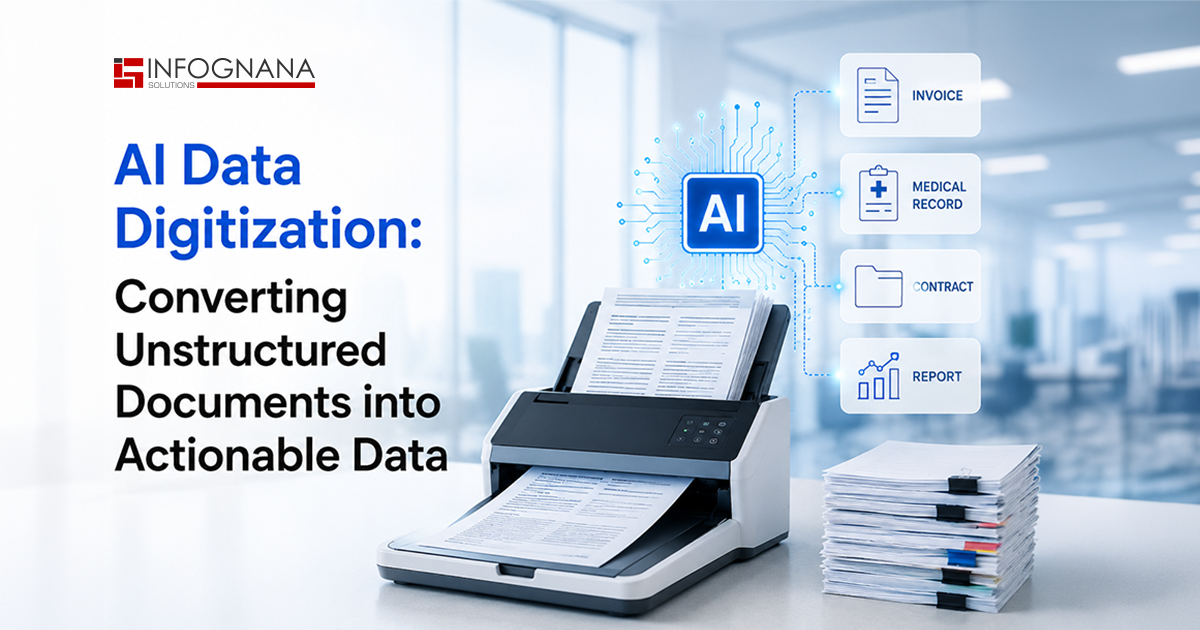
Most businesses face a common challenge with unstructured data. In many offices, filing cabinets go untouched, shared drives are rarely searched, scanned archives are ignored, and important decisions are hidden deep in email threads. According to Gartner, 80 to 90% of enterprise data is unstructured, and much of it is ‘dark data’, collected, stored, paid for, but never analyzed. Document digitization services address this issue directly. AI-powered data digitization turns unstructured documents into structured, searchable, and useful data for the entire organization. The aim is not just to digitize more documents, but to transform their contents into business intelligence that drives action. This is what sets modern digital document processing apart from simple scanning projects of the past.
What Is Data Digitization?
Data digitization means turning physical documents and unstructured digital files into structured data that business systems can use, process, analyze, and integrate. In the past, digitization often meant just scanning and storing images, leaving the information inside inaccessible. Today’s document digitization services do much more. They extract key details, understand the context, check the data against business rules, send it to operational systems, and reveal insights that were previously hidden. The input stays the same, but the results are completely different.
Why Is Most Enterprise Data Unstructured?
This is because most business activities naturally create unstructured data. Examples include scanned PDFs from suppliers, contracts written in Word and signed on paper, emails where decisions are buried in long replies, medical records dictated as narratives, handwritten shipment documents, compliance reports as image-based PDFs, and customer messages across email, chat, and forms. Most enterprise content is unstructured by design. In fact, 95% of organizations say they need to manage unstructured information, and over 40% deal with it all the time.
What Goes Wrong When Documents Stay Unstructured?
Three common problems appear in most organizations. First, finding information becomes slow, as employees spend too much time searching through scattered files and systems. This causes delays in approvals, customer service, claims, reporting, and decision-making. Second, operational costs rise because repetitive data entry, sorting, manual checks, and reviews require more staff without increasing productivity. Third, human errors increase, leading to inconsistent data, extraction mistakes, duplicate entries, and compliance issues that affect later processes. Workflows can’t keep up without proportional staffing and infrastructure increases. And compliance risk rises: healthcare, finance, insurance, and legal teams face missing records, inconsistent validation, audit failures, and security vulnerabilities, all of which trace back to documents that were never properly structured in the first place. The longer the unstructured data sits, the more expensive it gets to ignore.
What makes AI Data digitization Different from OCR Document Processing?
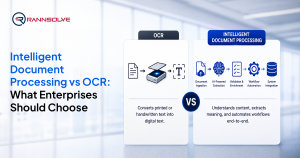
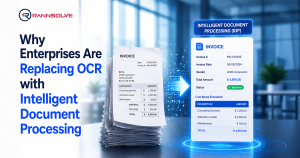
Traditional digitization focused on scanning documents, storing files, and turning images into text. AI-powered document digitization services do all this and more. They use OCR, AI-based extraction, machine learning, NLP, smart validation, workflow automation, and Generative AI. While basic OCR document processing only recognizes characters, AI data digitization automates the whole process, from when a document arrives, through extraction, validation, and integration, until the data appears cleanly in systems like ERP, CRM, or EHR. The result is not just a digital copy, but useful business information.
How Does AI Data Digitization Actually Work?
1. Document Ingestion
Documents come in from all the channels a business uses, such as scanners, emails, cloud platforms, business applications, mobile uploads, and old archives. The platform standardizes everything into one processing queue, so the rest of the workflow does not need to worry about the source of each document.
2. Intelligent Document Classification
AI models identify the type of each document: invoice, contract, medical record, claim form, or bill. AI models determine the type of each document, such as invoices, contracts, medical records, claim forms, bills of lading, or compliance reports. This classification replaces the manual sorting that used to take up entire mailrooms and automatically sends each document to the right workflow. It includes dates, invoice totals, shipment details, policy information, patient data, financial records. Structured and unstructured documents flow through the same extraction layer, which is the part that traditional OCR-based document processing could never reliably handle.
4. Contextual Understanding
Natural Language Processing helps the system understand meaning. For example, it knows that the date next to ‘Due’ is the payment due date, that a clinical note describes a diagnosis, and that a signature block belongs to an authorized approver. This context boosts extraction accuracy from the 60% OCR baseline to 99% or more, turning digital document processing into real document intelligence.
5. Validation and Quality Control
AI-powered validation checks catch missing data, duplicate records, formatting issues, and unusual values before they reach other systems. Human reviewers step in for exceptions that need judgment, keeping accuracy high without creating the manual backlog that old OCR document processing systems often caused.
6. Enterprise Integration
The extracted data is directly imported into ERP systems, CRM platforms, EHR systems, analytics tools, and workflow platforms. This step turns data digitization from a back-office task into a key part of business operations. Document digitization services become the starting point for all downstream systems.
Why Are Enterprises Investing in AI Data Digitization Now?
Digital transformation needs accessible, structured data, and businesses cannot fully automate if important information stays locked in unstructured files. Efficiency improves when manual document handling is reduced. Better business decisions happen faster as structured data improves reporting, analytics, forecasting, and visibility. Costs drop as administrative work, delays, corrections, and storage problems decrease. Compliance also improves, since AI-powered validation keeps audit readiness, document tracking, and data consistency ongoing rather than occasional. Industries are leading the shift. Healthcare organizations are digitalizing patient records, clinical documentation, claims forms, prior-authorization files, and medical charts, thereby reducing the administrative burden that drives clinician burnout. Financial institutions automate invoice processing, KYC documentation, loan applications, compliance reporting, and account onboarding, which is why BFSI is the largest single segment of the document intelligence market today. Insurance provider digitalizing claims forms, policy records, underwriting documents, and customer files, accelerating turnaround time without sacrificing accuracy. Logistics and supply chain teams process bills of lading, customs documentation, shipment records, and freight paperwork, where document variety is highest, and document digitization services often pay back fastest. And legal organizations digitalize contracts, case files, discovery documents, and compliance records, compressing manual review from weeks to days.
What Challenges Do Enterprises Actually Face During Data Digitization?
First, legacy systems can slow things down, as many businesses still use disconnected infrastructure that makes modernization harder. Second, document types vary widely, structured forms, handwritten files, scanned images, multilingual records, and unstructured documents all need to be processed together. Third, security and compliance are essential, with encryption, access controls, audit features, and secure environments required for regulated industries. Finally, change management is key; training, aligning operations, redesigning workflows, and having a clear governance strategy are just as important as the technology.
How rannsCDE Powers Enterprise Document Digitization Services
rannsCDE is Rannsolve’s AI-powered platform for Intelligent Document Processing, designed to modernize business document workflows and speed up AI data digitization from start to finish. The platform uses advanced Large Language Models, unique AI-vision algorithms, and 25 years of Rannsolve’s data expertise in one system. It reads structured, semi-structured, and unstructured documents with 99.5% extraction accuracy. With over 300 pre-trained templates for healthcare, finance, legal, insurance, and e-commerce, it delivers value much faster than building a digitization pipeline from scratch. digital document processing. Intelligent classification automatically identifies new document types. AI-powered data extraction handles every common format. Human-in-the-loop validation covers the edge cases that still need human judgment. Workflow automation routes approvals and integrations without manual handoffs. Enterprise integrations plug rannsCDE into ERP, CRM, EHR, and cloud environments. And cloud, private cloud, and on-premise deployment options keep the platform aligned with whatever compliance posture your business already runs under. Talk to our document digitization expert now.
FAQs
Industries like healthcare, finance, insurance, logistics, and legal rely on Document Digitization Services to convert large volumes of unstructured data into usable digital information.
Businesses adopt Digital Document Processing to automate data extraction, reduce manual effort, and gain faster, more accurate insights from unstructured documents.
Yes, OCR Document Processing combined with AI can accurately capture and convert handwritten and complex unstructured documents into structured data.
Rannsolve delivers advanced Document Digitization Services that use AI, automation, and validation to transform documents into reliable, system-ready data.
Manual workflows in Digital Document Processing often lead to slow turnaround times, higher operational costs, and increased risk of errors and compliance issues